*
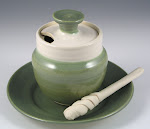
spun from still gray clay
drinking vessel flowers rise
quick stems opening
(*the mugventure continues.)
Friday, June 18, 2010


Tuesday, June 1, 2010
Muggus Jumbo-issimus: It's all About the Process
Six hundred grams of clay makes a whopping big mug. In fact, it makes a beer stein. Today I put the handles on 24 beer stein-sized mugs.
Late last week these were thrown, with little to trim away later. A day later, the bottoms were "thumbed off" around the edges to clean them up. This is satisfying. It's just a firm thumb swipe all around the bottom edge to pull off extra clay. It beats trimming with a tool for speed and casual accuracy, and it feels...elemental. A sort of visceral clay-thumb connection takes place.
The mugs were "fluted" after that. I took a loop-shaped tool to the first mug, and swiped a shallow line down the outside, starting at the center of the belly and sliding straight down to the bottom, over curves, like riding a sled with a single runner down a hill. (You have to do this with a sure touch, or what you've done just looks like an uneven gouge.) This move creates an indentation about 1/8" wide and less than 1/16" deep. Smooth little glides of clay come off the loop tool as you go along. Then- this is a nice contemplative action- I followed the first swipe with another beside it, then another, all around the mug. The lines go marching, the potter gets in the zone, and this is called "fluting".
Fluting was followed by sponging off. Cutting a flute in a soft-ish pot leaves little burrs of clay along the cuts. A well squeezed-out sponge moving up and down swipes the burrs away and leaves clean lines that will not be sharp-edged after they've been fired. A nice upward delicate swipe gives the top of each flute a little arch. I know I'm getting into the minutiae of the flute here, but hey, I'm alone in the studio much of the day, I ought to find my work engrossing. Flutes are more interesting than my navel for gazing purposes.
By the time I was done thumbing and fluting, the day was at an end and so was the work week. About 8 pieces of dry cleaner plastic covered the board of mug bodies for a couple of days. I couldn't get to them, but they were on my mind. Well, thinking of unfinished mugs beats worrying about my kids, traveling in Cambodia and Laos on vacation.
Thumbing. Fluting. Now, pulling handles. Today was handle day. The Muggi Jumbo-issimi needed sturdy handles. 16 to 20 ounces of fluid have to be held up comfortably. Even if your wrist gives out from the weight, the handle should be up to the task. I paused to consider the length and width of handles required. Then, with a couple of long boards set up to take the handles as I made 'em, I "pulled" 24 handles, plus a few spares in case.
Finally, I applied the handles, and added thumb rests to top each one. Re-covered lightly with plastic in my new, improvised damp cabinet (baker's rack plus plastic- thanks, Dirtkicker Pottery, for the idea!), the mugs and handles are downstairs communing with one another and exchanging body fluids... I mean, evening out the dampness between body and handle, so they will not crack apart by drying too quickly. (But who knows what really goes on when the mugs are mugging alone together downstairs.) Now I can think of what I would like to make next. I think it will be other sorts of mugs and cups. My website needs a design-a-mug page and I want to give the people photos of their size-shape-color-handle type options!
Engrossing, muggy First of June, 2010.
Late last week these were thrown, with little to trim away later. A day later, the bottoms were "thumbed off" around the edges to clean them up. This is satisfying. It's just a firm thumb swipe all around the bottom edge to pull off extra clay. It beats trimming with a tool for speed and casual accuracy, and it feels...elemental. A sort of visceral clay-thumb connection takes place.
The mugs were "fluted" after that. I took a loop-shaped tool to the first mug, and swiped a shallow line down the outside, starting at the center of the belly and sliding straight down to the bottom, over curves, like riding a sled with a single runner down a hill. (You have to do this with a sure touch, or what you've done just looks like an uneven gouge.) This move creates an indentation about 1/8" wide and less than 1/16" deep. Smooth little glides of clay come off the loop tool as you go along. Then- this is a nice contemplative action- I followed the first swipe with another beside it, then another, all around the mug. The lines go marching, the potter gets in the zone, and this is called "fluting".
Fluting was followed by sponging off. Cutting a flute in a soft-ish pot leaves little burrs of clay along the cuts. A well squeezed-out sponge moving up and down swipes the burrs away and leaves clean lines that will not be sharp-edged after they've been fired. A nice upward delicate swipe gives the top of each flute a little arch. I know I'm getting into the minutiae of the flute here, but hey, I'm alone in the studio much of the day, I ought to find my work engrossing. Flutes are more interesting than my navel for gazing purposes.
By the time I was done thumbing and fluting, the day was at an end and so was the work week. About 8 pieces of dry cleaner plastic covered the board of mug bodies for a couple of days. I couldn't get to them, but they were on my mind. Well, thinking of unfinished mugs beats worrying about my kids, traveling in Cambodia and Laos on vacation.
Thumbing. Fluting. Now, pulling handles. Today was handle day. The Muggi Jumbo-issimi needed sturdy handles. 16 to 20 ounces of fluid have to be held up comfortably. Even if your wrist gives out from the weight, the handle should be up to the task. I paused to consider the length and width of handles required. Then, with a couple of long boards set up to take the handles as I made 'em, I "pulled" 24 handles, plus a few spares in case.
Finally, I applied the handles, and added thumb rests to top each one. Re-covered lightly with plastic in my new, improvised damp cabinet (baker's rack plus plastic- thanks, Dirtkicker Pottery, for the idea!), the mugs and handles are downstairs communing with one another and exchanging body fluids... I mean, evening out the dampness between body and handle, so they will not crack apart by drying too quickly. (But who knows what really goes on when the mugs are mugging alone together downstairs.) Now I can think of what I would like to make next. I think it will be other sorts of mugs and cups. My website needs a design-a-mug page and I want to give the people photos of their size-shape-color-handle type options!
Engrossing, muggy First of June, 2010.
Monday, May 24, 2010
Swamp of Despair
Unloaded the bisque kiln today, faithful readers. The very kiln filled with- you guessed it- 10” dinner plates. Dinner plates made from my new dark clay, with even darker chocolate brown slip brushed lavishly on each center like large thin Swiss Fudge cookies. They were lovely when they were raw, before they were dried and fired.
But then I unloaded this bisque kiln. Ugh. UGH! Bad plates, bad! Into the trash with you! And you!
The smooth-as-pudding slip in the plate centers crackled and lifted delicately in the heat of the kiln like a finely textured salt marsh on the fringes of the Kalahari. Not. Ideal.
The plates themselves, so nice and light in weight, had dried unevenly. TOO thin! The bottoms of two were cracked all around, ready to drop out.
The rest were okay, maybe… It is so tiring to achieve “okay, maybe” when what I want is “Oooohhh, yes.” I won't even know till they are glazed and fired again whether the Kalahari slip can be compensated for with a glaze layer on top. I can only grit my teeth and hope.
The kiln also contained nice big cereal bowls. So the electricity used to fire this otherwise stinkin’ load will at least be paid for when I finally sell the bowls. People like big cereal bowls. Cereal bowls and nice big mugs are bread and butter.
There is a symbolic kayak waiting to ride me out of this Swamp of Despair. It is a day spent making mugs, and a day or two of trimming and handle-making to complete them. And that, my friends, is this week’s antidote. Then next week, if I’ve gathered up enough Plate Commitment to continue, I’ll have another go.
Sigh.
But then I unloaded this bisque kiln. Ugh. UGH! Bad plates, bad! Into the trash with you! And you!
The smooth-as-pudding slip in the plate centers crackled and lifted delicately in the heat of the kiln like a finely textured salt marsh on the fringes of the Kalahari. Not. Ideal.
The plates themselves, so nice and light in weight, had dried unevenly. TOO thin! The bottoms of two were cracked all around, ready to drop out.
The rest were okay, maybe… It is so tiring to achieve “okay, maybe” when what I want is “Oooohhh, yes.” I won't even know till they are glazed and fired again whether the Kalahari slip can be compensated for with a glaze layer on top. I can only grit my teeth and hope.
The kiln also contained nice big cereal bowls. So the electricity used to fire this otherwise stinkin’ load will at least be paid for when I finally sell the bowls. People like big cereal bowls. Cereal bowls and nice big mugs are bread and butter.
There is a symbolic kayak waiting to ride me out of this Swamp of Despair. It is a day spent making mugs, and a day or two of trimming and handle-making to complete them. And that, my friends, is this week’s antidote. Then next week, if I’ve gathered up enough Plate Commitment to continue, I’ll have another go.
Sigh.
Monday, May 10, 2010
Dinner Plate Challenge
Plates. Despite 25 years of making pots, even I have never cared much about ‘em. Plates are dinnerware, and I haven’t really done dinnerware. Making dinnerware means throwing one sort of form repeatedly to the same dimensions, with the same size and angle of rim, the same foot lifting it the same distance from the table. This, sadly, has not been my forte. The gauntlet, however, has been thrown down.
Three weeks ago, I approached a gallery about selling my work, and the owner had a request. Did I make 10” dinner plates? Would I make them of rough brown clay, with not too large a rim?
So now, yes, I will. I’m not sure she’ll want them when I’m done. She has an image in her head of what she wants. I have an image in mine of what I’m willing to do. I’m not even sure I know how to charge the right price. Even so, this challenge is about to break the dinnerware (sorry, bad pun) barrier at M. S. Pottery.
I found a teaching video that told me exactly what I needed to know.
If I can get muscles like this potter's from just throwing plates, that would be cool.
Besides the technique demo, this woman even tells me how much clay (about 3 lbs. per plate), how wide to make the wet plate (12”, which will shrink to 10”), and how to form the rim. Basically, I knew conceptually how to do this, after all, but a little extra guidance got the motion going.
Off I went to Ceramic Supply, got some brown clay that was NOT rough (an executive decision; rough clay scratches your cabinet and table- bad for sales) and got down to business.
It isn't rocket science. I got it pretty quickly. Why'd I wait so long to go for it? Shapes and sizes were approximately similar. Angle of rim had a learning curve, though. Rims all need to match, so the plates can be shelved in a nice neat stack. But rims like to lift when drying. While you are making them, each one has to be made to the same angle as the next, so they will lift at the same angle as they dry. I had to recycle the ones with rim differences back into lumps. After a day's work, only six were set to dry in the kiln room. This morning I threw another 6 on my handy dandy old Lockerbie kick wheel, and I'm about to thrown some more. I’m shooting for a couple dozen this week, or till I run out of brown clay, since this is a trial run and I only bought 100 lbs. Then back to the gallery owner, who can take them or not. If they’re nice, the price is right, and I can scoot some traffic to my website, they may sell there too.
Challenges keep the work fresh, and the work is always having to be fresh, because challenges are perpetual.
Next, maybe, the elusive and so far unsuccessful Seder plate..?
Three weeks ago, I approached a gallery about selling my work, and the owner had a request. Did I make 10” dinner plates? Would I make them of rough brown clay, with not too large a rim?
So now, yes, I will. I’m not sure she’ll want them when I’m done. She has an image in her head of what she wants. I have an image in mine of what I’m willing to do. I’m not even sure I know how to charge the right price. Even so, this challenge is about to break the dinnerware (sorry, bad pun) barrier at M. S. Pottery.
I found a teaching video that told me exactly what I needed to know.
If I can get muscles like this potter's from just throwing plates, that would be cool.
Besides the technique demo, this woman even tells me how much clay (about 3 lbs. per plate), how wide to make the wet plate (12”, which will shrink to 10”), and how to form the rim. Basically, I knew conceptually how to do this, after all, but a little extra guidance got the motion going.
Off I went to Ceramic Supply, got some brown clay that was NOT rough (an executive decision; rough clay scratches your cabinet and table- bad for sales) and got down to business.
It isn't rocket science. I got it pretty quickly. Why'd I wait so long to go for it? Shapes and sizes were approximately similar. Angle of rim had a learning curve, though. Rims all need to match, so the plates can be shelved in a nice neat stack. But rims like to lift when drying. While you are making them, each one has to be made to the same angle as the next, so they will lift at the same angle as they dry. I had to recycle the ones with rim differences back into lumps. After a day's work, only six were set to dry in the kiln room. This morning I threw another 6 on my handy dandy old Lockerbie kick wheel, and I'm about to thrown some more. I’m shooting for a couple dozen this week, or till I run out of brown clay, since this is a trial run and I only bought 100 lbs. Then back to the gallery owner, who can take them or not. If they’re nice, the price is right, and I can scoot some traffic to my website, they may sell there too.
Challenges keep the work fresh, and the work is always having to be fresh, because challenges are perpetual.
Next, maybe, the elusive and so far unsuccessful Seder plate..?
Monday, April 26, 2010
How Was the Show?
The show is over and, to answer the question I have been asked often in the last week, it was good.
What does the question mean, “How was your show?” Well, you reading this, what do you think? I would really like to know. Does it mean, “Did people show up?” Does it mean “Did people buy your pottery?” Does it mean, “Did you enjoy the experience?” Does it mean “Did you make money?” Help me interpret.
My usually reply to “How was your show?” is, “Good.” A vague question, a general answer. Sometimes there’s a further question: “Did people buy your work?” I respond to that, “Yes, they did.” To the further question- and I wonder if you agree that this is pretty nosy? “Did you make money?” I want to say, “How is your salary lately?” but I don’t. I just say, “It was a good show,” and I smile, which people can read any way they like. People don’t mean to pry, they were just, um, curious. I just realize some people (not you, of course!) are kind of clueless about making pots; feel free to lead the uninformed to this blog! Call it public service to potters... Explain about the hobby versus work thing, OK?
So this is a nice time to point out that pricing, labeling, writing up inventory, packing, hauling, unpacking, setting up show furniture and pottery, and manning my booth is just the laborious bump at the end of months of making & firing cycles in the studio. What I have invested in a show began long before the show. It is not a hobby, it is not a game, it is not “How lovely, so relaxing” as is one’s experience at paint-your-own shops. (It's true; I'm a bit tired of hearing "How relaxing.") Shows are one facet of a studio and retail website program.
Being a potter is a creative, exciting, heavy-lifting, muscle-using, dirty, messy, visceral experience that wraps up design ideas, powers of observation and active, continuing education, physical ability and tenacity. I do love to make pottery. It is work. I am trying to make it pay better. Sometimes it does.
Having said that, it was a good show. We had various booths, made up of 18 varied painters, four jewelers of different sorts, one local chocolatier, and me. The crowd was heavy for our one-day event, which had been widely advertised in large mailings, emails, posters, and newspaper items. I made money for me, for the gallery’s cut, and the 15% donation for the social service organization that benefited from this event. I enjoyed working with gallery and service organization people. That, in my opinion, is good.
Shows, additionally, are not just about money (though heck, I can only put this plainly, I want the people to buy). This show was good both because of the reasons above, and because I got to talk to people.
Talking to people about the work at a show is illuminating for me, not just them. The people make me think! People wonder about utility. They wonder about why I designed a piece a certain way and not another. Couldn’t that goblet use a plate under it? Shouldn’t the creamer be a bit larger, with a wider mouth? How did I get this beautiful color, this interesting texture? Would I make mustache cups? Salt shakers? Smaller oval serving bowls? Would I lower the price on this? Alternatively- Why are my prices so low? (I even got a kiss for the affordability of a certain vase! And a discussion with a dear friend about how high the price was on another vase, and why I believe it is justified. Go figure.) Then I assess my work based on what people have said.
Feedback! One of the best reasons for doing a show, after sales!
I came home and made a list the next day of items to modify or try next. That's GOOD. Thanks for feedback as well as sales, people.
It also made me happy to have so many comments about how my work has changed or grown in the last 25 years. (Yes, I know that is a no-brainer. Experience changes the work all the time. Still, if I don’t come out of the basement periodically and show the work, who will know it’s nicer now?)
And that's how the show was. It was "Good."
What does the question mean, “How was your show?” Well, you reading this, what do you think? I would really like to know. Does it mean, “Did people show up?” Does it mean “Did people buy your pottery?” Does it mean, “Did you enjoy the experience?” Does it mean “Did you make money?” Help me interpret.
My usually reply to “How was your show?” is, “Good.” A vague question, a general answer. Sometimes there’s a further question: “Did people buy your work?” I respond to that, “Yes, they did.” To the further question- and I wonder if you agree that this is pretty nosy? “Did you make money?” I want to say, “How is your salary lately?” but I don’t. I just say, “It was a good show,” and I smile, which people can read any way they like. People don’t mean to pry, they were just, um, curious. I just realize some people (not you, of course!) are kind of clueless about making pots; feel free to lead the uninformed to this blog! Call it public service to potters... Explain about the hobby versus work thing, OK?
So this is a nice time to point out that pricing, labeling, writing up inventory, packing, hauling, unpacking, setting up show furniture and pottery, and manning my booth is just the laborious bump at the end of months of making & firing cycles in the studio. What I have invested in a show began long before the show. It is not a hobby, it is not a game, it is not “How lovely, so relaxing” as is one’s experience at paint-your-own shops. (It's true; I'm a bit tired of hearing "How relaxing.") Shows are one facet of a studio and retail website program.
Being a potter is a creative, exciting, heavy-lifting, muscle-using, dirty, messy, visceral experience that wraps up design ideas, powers of observation and active, continuing education, physical ability and tenacity. I do love to make pottery. It is work. I am trying to make it pay better. Sometimes it does.
Having said that, it was a good show. We had various booths, made up of 18 varied painters, four jewelers of different sorts, one local chocolatier, and me. The crowd was heavy for our one-day event, which had been widely advertised in large mailings, emails, posters, and newspaper items. I made money for me, for the gallery’s cut, and the 15% donation for the social service organization that benefited from this event. I enjoyed working with gallery and service organization people. That, in my opinion, is good.
Shows, additionally, are not just about money (though heck, I can only put this plainly, I want the people to buy). This show was good both because of the reasons above, and because I got to talk to people.
Talking to people about the work at a show is illuminating for me, not just them. The people make me think! People wonder about utility. They wonder about why I designed a piece a certain way and not another. Couldn’t that goblet use a plate under it? Shouldn’t the creamer be a bit larger, with a wider mouth? How did I get this beautiful color, this interesting texture? Would I make mustache cups? Salt shakers? Smaller oval serving bowls? Would I lower the price on this? Alternatively- Why are my prices so low? (I even got a kiss for the affordability of a certain vase! And a discussion with a dear friend about how high the price was on another vase, and why I believe it is justified. Go figure.) Then I assess my work based on what people have said.
Feedback! One of the best reasons for doing a show, after sales!
I came home and made a list the next day of items to modify or try next. That's GOOD. Thanks for feedback as well as sales, people.
It also made me happy to have so many comments about how my work has changed or grown in the last 25 years. (Yes, I know that is a no-brainer. Experience changes the work all the time. Still, if I don’t come out of the basement periodically and show the work, who will know it’s nicer now?)
And that's how the show was. It was "Good."
Sunday, April 18, 2010
Tired for a Good Reason
Thanks for coming to the show, and thanks to all of you who bought some of my pottery! I enjoyed the day and hope you did, too.
Those of you who didn't make it, see you another time perhaps. More nice pots remain in need of homes...
Please be aware that the show will remain up until Thursday, April 29th, and you are most welcome to visit during L&M Gallery hours, although the artists will not be present. If you call me or email me, I will try to be available to go with you if you want the company. Otherwise, some pots are available through my website, http://www.mimistadlerpottery.com.
It's good to get feedback at shows, and see what people like or need or want.
Tomorrow, back I go to the studio, to work on some requests. And now, ready to give up being dressed up and "on" for the day, I bid you a comfortable and restful night.
Those of you who didn't make it, see you another time perhaps. More nice pots remain in need of homes...
Please be aware that the show will remain up until Thursday, April 29th, and you are most welcome to visit during L&M Gallery hours, although the artists will not be present. If you call me or email me, I will try to be available to go with you if you want the company. Otherwise, some pots are available through my website, http://www.mimistadlerpottery.com.
It's good to get feedback at shows, and see what people like or need or want.
Tomorrow, back I go to the studio, to work on some requests. And now, ready to give up being dressed up and "on" for the day, I bid you a comfortable and restful night.
Saturday, April 17, 2010
Hi-ho, Hi-ho, It's Off to Show I Go
Tomorrow brings an art show to Elizabeth, New Jersey at L&M Gallery. I’m in the show again this year. It’s a fundraiser for the food pantry of a local social service organization, Jewish Family Services, which caters to interdenominational clients. This is a great organization, providing job and personal counseling, helping qualifying clients with rent or food, providing Meals on Wheels for older clientele. Last year was its first art show, and we raised lots of necessary funds in a difficult economy.
I don’t mind at all being the only potter. The rest are painters, jewelers, a nature photographer and a chocolatier. We have the whole large, bright second floor, and we are an interesting group.
I couldn’t be more excited about it. Since I’ve been doing only one show a year, I put lots of energy into this. I have more than 75 pieces of pottery set up, ready for the opening at 1 PM for patrons and sponsors, ready for walk-ins at 2. Then I am happy and primed to chat, explain, kid around, promote, and sell pots.
It made the weekend to-do section of the Star Ledger, under the heading “Benefit”! I hope that brings in some people.
Meanwhile, if you haven’t been to my website, it’s up in a new version, as of this week. Go to http://www.mimistadlerpottery.com to see it. I have more pottery than made it onto the site, but more will go up over time. So please go there, and I would love feedback if you haven’t left some already: mimi@mimistadlerpottery.com. There have been some glitches viewing it on Internet Explorer, which I hope have now been fixed. (If you have IE as your browser, let me know how the site looks.)
I will have some photos to post on Monday. Come back and see! Wish me luck!
I don’t mind at all being the only potter. The rest are painters, jewelers, a nature photographer and a chocolatier. We have the whole large, bright second floor, and we are an interesting group.
I couldn’t be more excited about it. Since I’ve been doing only one show a year, I put lots of energy into this. I have more than 75 pieces of pottery set up, ready for the opening at 1 PM for patrons and sponsors, ready for walk-ins at 2. Then I am happy and primed to chat, explain, kid around, promote, and sell pots.
It made the weekend to-do section of the Star Ledger, under the heading “Benefit”! I hope that brings in some people.
Meanwhile, if you haven’t been to my website, it’s up in a new version, as of this week. Go to http://www.mimistadlerpottery.com to see it. I have more pottery than made it onto the site, but more will go up over time. So please go there, and I would love feedback if you haven’t left some already: mimi@mimistadlerpottery.com. There have been some glitches viewing it on Internet Explorer, which I hope have now been fixed. (If you have IE as your browser, let me know how the site looks.)
I will have some photos to post on Monday. Come back and see! Wish me luck!
Subscribe to:
Posts (Atom)