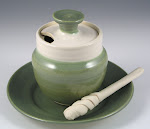
Going from potter to artist-entrepreneur is a sea change.
After 25 years learning and plying my craft, I keep finding out how much I don’t know about selling pottery.
Fortunately, there are books, articles and organizations to educate artists if you look for them.
Apparently many ninth graders learn the acronym SMART, though I did not- Specific Measurable Attainable Realistic Timely. This is, for me, a reminder that my time to make art is not endless, so it had better be used judiciously.
This week I didn’t make new work (though I did fire a glaze test kiln Sunday.) Instead, on Monday I went to a half-day seminar on Business Savvy for Artists, given by a very savvy consultant through the Arts Council of the Morris Area, and got a very broad overview of some sound business principles. There’s only so much to learn in four hours, so a list of useful books in relevant areas means I have some reading to do for a while. One thing I learned for sure is that my business card is a very poor design. (Well, I really knew that. Have you seen my sad business card? I've been penning in contact information.)
Meanwhile, Guerrilla Marketing on the Internet by Jay Conrad Levinson et al is my current textbook. There are also some good articles about using social media, that I found on Yahoo.
I never read all the way through the golden oldie, The 7 Habits of Highly Effective People, which is waiting for me with a bookmark where I last left off. (The bookmark is the very beautiful business card of another potter.) I’ve been working on some interesting paradigm shifts for Mimi Stadler Pottery. The result should be greater intensity in the surfaces and colors of my work in the coming months.
As a result of the Arts Council workshop, I have a further reading list at least six books long. Well, I've got plenty of notepaper, and a thirst to know and grow.
The key point here is I didn’t learn how to be a businessperson when I was learning (at Kean University in Union, NJ) to be a potter. The lack of business courses is a serious flaw in art education almost anywhere, not just at Kean.
Tuesday, I met with my favorite web builder. Deborah. The website is my business brochure and shop. Deborah's done a very good job so far, though I made the mistake of not consulting with a web designer (not the same as builder) first, so that my website took a very long time to come together. I have no clue about html, and Deborah had not done an artist’s shop-type website before. We made some poor design decisions the first time around. The site has had to evolve s-l-o-w-l-y, as we saw what was missing or fixed errors of poor judgment. It has mostly come together, but wow, it's been a long process. You KNOW it’s not good when the artist does not want to go to her own website for a visit. It had issues, now resolved. And I think it's kinda pretty, too.
Wednesday, I took a box of my pottery to a cooperative gallery an hour away, to show a committee of artists on its board my work, and let them decide if it has a place in their shop. (They will let me know. They have a waiting list.) I am very interested in the co-op gallery concept, and wish there was one locally.
Thursday, as you know, was Thanksgiving. Among all the other aspects of life for which I am grateful, I am thankful to be healthy and capable and working in a field I love. I’m thankful that I have the capacity to continue learning new angles of an old business.
My normal studio workweek ends with Thursday. Friday is my day for cooking, setting the house to rights, and errands, as I prepare for the Sabbath that falls in the evening. Luckily I don’t need any books to tell me how to do that. Like Jewish homemakers everywhere, I’ve done the pre-Sabbath routine week after week for years. It’s like making Thanksgiving every Friday- clockwork production.
Next week, happily, it’s back to the clay with me. I owe pots I haven't made yet (Specific), I have no large beautiful bowls in stock (Attainable), and I just received a commission for an item of Judaica (wine goblet and plate) that I must get right on (Timely). (Pottery Making Illustrated had an article on one-piece goblets back in 2008, and I kept the issue. I want to try the technique.) The web site needs Judaica urgently, too (Measurable), leading to work on designing and making a series of wine goblets and plates in various group configurations, as well as new washing cups and mezuzah cases. In fact, that’s at least a month’s work, right there.
When I say what it is I do, I sometimes hear, "Potter? Oooh, you must have so much fun!" I just smile. I do have fun. But maybe there's the occasional smidgeon of work in it now and then...
Friday, November 26, 2010


Thursday, November 18, 2010
On Burping Glazes, or the Perfect Nature of Imperfection
Why isn’t the band of glaze color perfectly even around the rims of my mugs and bowls?
When I put a band of color on for contrast at the rim, why does it waver and speckle? Why isn’t it a precise, clean, perfect, (come on, anal) line? Commercial mugs and bowls have perfect lines. Is my mug or bowl inferior?

It all starts with how I apply the glaze. When it comes time to glaze the nekkit once-fired pots, I don’t usually sit there with a little bitty brush and make painstaking decorations. I turn the piece over and dip it right into the 4-gallon bucket of wet glaze. Or, if it is too big for the bucket, I pour the glaze all over it. Sometimes I glaze the inside one color and the outside another. Or I dip the piece all at once, inside and out both, in one practiced dunk, and when the thirsty pottery has absorbed all the water out of the glaze and dried again, I may dip it back, just the rim, in another bucket of a different glaze color.
This is where imperfection rears its juvenile delinquent head.
I admit it. I’m imperfect. I can’t hold every single pot exactly level when I glaze it. Sometimes I achieve this nirvana, but often the pots enter their glaze bath very slightly crooked. They sneer at my inability to see through the plastic bucket and tell if I’ve got the exact same depth of rim dipped all around, so that the air trapped inside the upside down bowl maintains even resistance all across, to the surface of the glaze in the bucket.
See, the pot wants to be dipped exactly straight, or it burps. Some air sneaks inside if it is held at even a slight angle, and a little spit-up of color hops past its allotted line in impish, messy glee.
Sometimes the son of a gun sucks up the little gush of air really fast, so that the bucket throws up a small spatter of droplets of the wet rim color right into the interior of the pot.
Beautiful clean white interior? Freckled now. Trying to scrape off the freckles is going to damage the glaze under them. So there they will remain.
Freckled, juvenile delinquent pots. They are a lesson in the beauty of imperfection.
Look at it this way. (I know I have to.) Every little speckle and out-of-the-ordinary overlap gives you something for your thumb to run over and your eye to contemplate. I know that you didn’t buy my mug or bowl because you wanted exactitude. You saw right away you weren’t getting that, even if you were getting something very nice. What you got was a piece of pottery nobody else had exactly, even if there were 10 similar ones at my show or in the gallery. No two are precisely identical. It’s the unpredictable thing, like glazes that burp in the bucket, that make each one of my production pots (multiples in a series) itself and not quite like another. It is the nature of humanness to be imperfect and I sure as heck am human when I make pottery.
Pottery making is a constant reminder of humility. Glazes will burp and spit despite me, or to spite me, maybe. It’s like life. There’s no such thing as perfect, and if you had it, it might feel a little wrong.
When I put a band of color on for contrast at the rim, why does it waver and speckle? Why isn’t it a precise, clean, perfect, (come on, anal) line? Commercial mugs and bowls have perfect lines. Is my mug or bowl inferior?

It all starts with how I apply the glaze. When it comes time to glaze the nekkit once-fired pots, I don’t usually sit there with a little bitty brush and make painstaking decorations. I turn the piece over and dip it right into the 4-gallon bucket of wet glaze. Or, if it is too big for the bucket, I pour the glaze all over it. Sometimes I glaze the inside one color and the outside another. Or I dip the piece all at once, inside and out both, in one practiced dunk, and when the thirsty pottery has absorbed all the water out of the glaze and dried again, I may dip it back, just the rim, in another bucket of a different glaze color.
This is where imperfection rears its juvenile delinquent head.
I admit it. I’m imperfect. I can’t hold every single pot exactly level when I glaze it. Sometimes I achieve this nirvana, but often the pots enter their glaze bath very slightly crooked. They sneer at my inability to see through the plastic bucket and tell if I’ve got the exact same depth of rim dipped all around, so that the air trapped inside the upside down bowl maintains even resistance all across, to the surface of the glaze in the bucket.
See, the pot wants to be dipped exactly straight, or it burps. Some air sneaks inside if it is held at even a slight angle, and a little spit-up of color hops past its allotted line in impish, messy glee.
Sometimes the son of a gun sucks up the little gush of air really fast, so that the bucket throws up a small spatter of droplets of the wet rim color right into the interior of the pot.
Beautiful clean white interior? Freckled now. Trying to scrape off the freckles is going to damage the glaze under them. So there they will remain.
Freckled, juvenile delinquent pots. They are a lesson in the beauty of imperfection.
Look at it this way. (I know I have to.) Every little speckle and out-of-the-ordinary overlap gives you something for your thumb to run over and your eye to contemplate. I know that you didn’t buy my mug or bowl because you wanted exactitude. You saw right away you weren’t getting that, even if you were getting something very nice. What you got was a piece of pottery nobody else had exactly, even if there were 10 similar ones at my show or in the gallery. No two are precisely identical. It’s the unpredictable thing, like glazes that burp in the bucket, that make each one of my production pots (multiples in a series) itself and not quite like another. It is the nature of humanness to be imperfect and I sure as heck am human when I make pottery.
Pottery making is a constant reminder of humility. Glazes will burp and spit despite me, or to spite me, maybe. It’s like life. There’s no such thing as perfect, and if you had it, it might feel a little wrong.
Monday, November 15, 2010
Summer Days and Pottery Shows
Our Potters Guild pottery show this weekend was made up of pretty diverse people and their pretty diverse pottery. From the face jug potter who calls her little fellows by name as she chattily sets them among the fifty other pieces of colorful pottery on her table, to the quiet potter with just six groups of nine perfect pots each, we run a gamut of styles.
Here was a potter whose creamy white, glossy porcelain cups, plates and buttons are incised with personable barnyard animals and a kitchen dooryard mama. Her table was set up beside another potter's whose glazes are mostly as dark as the sky when the sun has just set, swirling with black and navy clouds and with highly textured, unglazed handles of deepest brown. Contrast!
Across the room another guild member had arrayed her crystalline vases and cups, each one having grown a surface of smooth crystals in sparkling colors in her kiln, looking as if she managed to flatten the insides of geodes and apply them delicately to her pots.
Aesthetics varied even more widely. One potter’s brightly glazed, shiny majolica earthenware bore little likeness to another potter’s arched and lobed stoneware across the room, in moody, rocklike grays, blues and browns, though both were tableware.
My own pottery on the right half of my shared table contrasted in intention with that of my tablemate to the left. My soft green, black, blue and white, homey pieces are clearly about function. My table mate's vases, bowls and teaware are really 360-degree canvases for her extremely elegant and quite beautiful drawings of fish, birds and trees. Though we are both functional potters, our work speaks two very different languages.
Some of us have been making our pottery for years. I’ve been at it for 25, but have shown my work less often than many with shorter potting lives. The woman I shared my wrapping-table shift with began with clay less than three years ago, but she was ready to show. Another, longtime guild member does five shows in November and December alone, and has a devoted following.
I took half a table for this show, thinking I might not have enough work for a whole, and then loaded it with nearly as many pots as it would bear. I could have had enough for a whole table in the end, but this is my first guild show in a while and I wanted to get the feel of the terrain again.

I wasn’t there on Saturday, the first day of the show, (it being the Sabbath, with no personal commerce,) but when I came in Sunday I found a few shards of a mug peeping from under my table. Someone had broken it the day before, and paid for it, so I had made back some of the table fee by accident. Two other mugs had sold Saturday, and that's all. Without the potter being there to jazz up the exchange and talk pottery with the customer, fewer pots are sold.
Still, on Sunday, when I was there, I sold only a jam jar and two little soy sauce dishes. (I did have higher expectations than that...) The jam jar customer loved the jar, “even though it’s imperfect, but of course that’s part of its charm.” She was energizing to talk to, another benefit of doing shows. And I acknowledge that the lid, being hand-built, wasn’t an absolutely perfect fit for the jar, which was wheel-thrown. It was only a pretty good fit. But I saw the customer studying and stroking the glaze on the front of the jar and knew they were a match.
If that’s all I sold, was it worth it, you ask? Was it worth the inventorying, pricing, tagging, packing, unpacking, setup, the day on my feet at the show, and the repacking of unsold work? (In short, you are asking, "How was the show?")
Here’s my conclusion. From noon to six I looked at pottery, wrapped pottery, and talked life and shop with my fellow potters, an interesting, fun and lively bunch. I was glad to be there. By the end of Sunday I was tired, not much richer, but happy enough. I was ready to pack up and head home to a new and different cycle of pottery-making already in process in my studio, with visions of a different sort of show setup next time. I have glazes to test and fish to carve. I am also thinking about how to make more money than I did this weekend. Tune in for the next show or the next gallery- or hey, come see it.
When I was about ten, my friend and I were wandering one summer day in a field near our neighborhood. We found panes of old window glass, and a mud puddle. I spread mud on a pane of glass and began trying to draw a landscape by sticking leaves onto the mud, using daisy, black-eyed-Susan and Queen Anne’s Lace petals like brushstrokes. My friend didn’t like to get dirty, and she thought I was a little nuts, but I was in a glory of summer innovation. The piece was as ephemeral as summer, too, drying and crumbling in a day, but it left an impression in my mind. Art out of mud, leaves and glass is spontaneous. Art out of clay, carved natural forms and glazes is a continuation of a thought pattern. Imagination is not dead. I suppose that I am still ten, along with being five times ten, when I am in my studio innovating.
Pot on.
Here was a potter whose creamy white, glossy porcelain cups, plates and buttons are incised with personable barnyard animals and a kitchen dooryard mama. Her table was set up beside another potter's whose glazes are mostly as dark as the sky when the sun has just set, swirling with black and navy clouds and with highly textured, unglazed handles of deepest brown. Contrast!
Across the room another guild member had arrayed her crystalline vases and cups, each one having grown a surface of smooth crystals in sparkling colors in her kiln, looking as if she managed to flatten the insides of geodes and apply them delicately to her pots.
Aesthetics varied even more widely. One potter’s brightly glazed, shiny majolica earthenware bore little likeness to another potter’s arched and lobed stoneware across the room, in moody, rocklike grays, blues and browns, though both were tableware.
My own pottery on the right half of my shared table contrasted in intention with that of my tablemate to the left. My soft green, black, blue and white, homey pieces are clearly about function. My table mate's vases, bowls and teaware are really 360-degree canvases for her extremely elegant and quite beautiful drawings of fish, birds and trees. Though we are both functional potters, our work speaks two very different languages.
Some of us have been making our pottery for years. I’ve been at it for 25, but have shown my work less often than many with shorter potting lives. The woman I shared my wrapping-table shift with began with clay less than three years ago, but she was ready to show. Another, longtime guild member does five shows in November and December alone, and has a devoted following.
I took half a table for this show, thinking I might not have enough work for a whole, and then loaded it with nearly as many pots as it would bear. I could have had enough for a whole table in the end, but this is my first guild show in a while and I wanted to get the feel of the terrain again.

I wasn’t there on Saturday, the first day of the show, (it being the Sabbath, with no personal commerce,) but when I came in Sunday I found a few shards of a mug peeping from under my table. Someone had broken it the day before, and paid for it, so I had made back some of the table fee by accident. Two other mugs had sold Saturday, and that's all. Without the potter being there to jazz up the exchange and talk pottery with the customer, fewer pots are sold.
Still, on Sunday, when I was there, I sold only a jam jar and two little soy sauce dishes. (I did have higher expectations than that...) The jam jar customer loved the jar, “even though it’s imperfect, but of course that’s part of its charm.” She was energizing to talk to, another benefit of doing shows. And I acknowledge that the lid, being hand-built, wasn’t an absolutely perfect fit for the jar, which was wheel-thrown. It was only a pretty good fit. But I saw the customer studying and stroking the glaze on the front of the jar and knew they were a match.
If that’s all I sold, was it worth it, you ask? Was it worth the inventorying, pricing, tagging, packing, unpacking, setup, the day on my feet at the show, and the repacking of unsold work? (In short, you are asking, "How was the show?")
Here’s my conclusion. From noon to six I looked at pottery, wrapped pottery, and talked life and shop with my fellow potters, an interesting, fun and lively bunch. I was glad to be there. By the end of Sunday I was tired, not much richer, but happy enough. I was ready to pack up and head home to a new and different cycle of pottery-making already in process in my studio, with visions of a different sort of show setup next time. I have glazes to test and fish to carve. I am also thinking about how to make more money than I did this weekend. Tune in for the next show or the next gallery- or hey, come see it.
When I was about ten, my friend and I were wandering one summer day in a field near our neighborhood. We found panes of old window glass, and a mud puddle. I spread mud on a pane of glass and began trying to draw a landscape by sticking leaves onto the mud, using daisy, black-eyed-Susan and Queen Anne’s Lace petals like brushstrokes. My friend didn’t like to get dirty, and she thought I was a little nuts, but I was in a glory of summer innovation. The piece was as ephemeral as summer, too, drying and crumbling in a day, but it left an impression in my mind. Art out of mud, leaves and glass is spontaneous. Art out of clay, carved natural forms and glazes is a continuation of a thought pattern. Imagination is not dead. I suppose that I am still ten, along with being five times ten, when I am in my studio innovating.
Pot on.
Monday, October 25, 2010
Carved Vases, Stage II
The four carved vases were bone dry and it was time to bisque fire them, then glaze them. But I don't think these pots lend themselves to regular glazing. Colored glazes might war with the complicated, busy carving, or mute it. I know from experience that clear glaze alone would be too dull on the buff colored stoneware clay body.
I had a couple of jars of underglazes, though, which are formulated to go on raw pots. There were only light blue and black underglazes, so that is what I used. The photos show the four vases with these underglazes, which I put on fairly dry with a small foam roller and a flat sponge brush. The surfaces of the vases have almost an ink-printed effect. They will be bisque-fired in the old reliable electric kiln later in the week. Afterward, I will clear-glaze over the fired underglazes and fire the pots again.


This is Stage II of the vase story. Tune back to see how the finished, clear-glazed vases come out. I can't wait to see, myself.
I had a couple of jars of underglazes, though, which are formulated to go on raw pots. There were only light blue and black underglazes, so that is what I used. The photos show the four vases with these underglazes, which I put on fairly dry with a small foam roller and a flat sponge brush. The surfaces of the vases have almost an ink-printed effect. They will be bisque-fired in the old reliable electric kiln later in the week. Afterward, I will clear-glaze over the fired underglazes and fire the pots again.


This is Stage II of the vase story. Tune back to see how the finished, clear-glazed vases come out. I can't wait to see, myself.
Tuesday, October 12, 2010
In the Carving Zone
The weeks have passed into a couple of months, and what busy months they've been! My studio stood almost abandoned in favor of major family events, religious observances and celebrations, and travel. I have been contemplating web marketing and show possibilities. I applied to a co op gallery. In general, I've been considering what is the real potential for profit. But my hands have touched very little clay and no glaze at all.
I decided to revisit an old favorite pastime. As you saw in the photo from August of the bowl with the bridal bouquet in it, I used to carve pots. The bowl in the photo is over a decade old, from a time I tried carving into bowls some semblance of those leaves and vines I love to draw so much. You need to work out before you can lift one of those carved bowls. Since they were made very thick (too thick, maybe 3/4") to accommodate deep carving, they are extremely heavy, maybe 10 lbs each. No one bought them, either because I had too high a price on them to reflect all that work, or because they are so heavy. I keep them stowed away gathering dust in the kiln room now, their fate undecided.
Finally returning to the studio last week, in a contemplative mode, I threw a group of new vases on my trusty Lockerbie kickwheel. The belly portions of these vases were thrown thick, perhaps 1/2" instead of the usual 1/8" or so. Next day, I trimmed foot rings on the bottoms of these, got out my carving tools with their variously shaped cutting surfaces, and set up a comfortable padded stool beside my wheel. Hands, head and carving tools entered the spontaneous zone, and the vases pictured are the result.


I kept carving till they felt light enough in weight and seemed "done." You probably know that "done" is an unquantifiable state if you start getting abstract in your design. There were no guidelines but my gut feeling. These individuals were so much fun that I lost track of time. A blank canvas can be a joyful thing.
I decided to revisit an old favorite pastime. As you saw in the photo from August of the bowl with the bridal bouquet in it, I used to carve pots. The bowl in the photo is over a decade old, from a time I tried carving into bowls some semblance of those leaves and vines I love to draw so much. You need to work out before you can lift one of those carved bowls. Since they were made very thick (too thick, maybe 3/4") to accommodate deep carving, they are extremely heavy, maybe 10 lbs each. No one bought them, either because I had too high a price on them to reflect all that work, or because they are so heavy. I keep them stowed away gathering dust in the kiln room now, their fate undecided.
Finally returning to the studio last week, in a contemplative mode, I threw a group of new vases on my trusty Lockerbie kickwheel. The belly portions of these vases were thrown thick, perhaps 1/2" instead of the usual 1/8" or so. Next day, I trimmed foot rings on the bottoms of these, got out my carving tools with their variously shaped cutting surfaces, and set up a comfortable padded stool beside my wheel. Hands, head and carving tools entered the spontaneous zone, and the vases pictured are the result.


I kept carving till they felt light enough in weight and seemed "done." You probably know that "done" is an unquantifiable state if you start getting abstract in your design. There were no guidelines but my gut feeling. These individuals were so much fun that I lost track of time. A blank canvas can be a joyful thing.
Thursday, August 19, 2010
A Plea for the Touching of Certain Art
Toshiko Takaezu's work at Princeton Art Museum is worth a look. I wish it could be touched. It is art made to be touched. I fell in deep like with a monolith of a piece, a tall black form rising like a classic vase,from a base let's say two or three feet in diameter, up to a rounded shoulder a couple of feet wider. Reminiscent of a classic vase form, it defies vasehood by being closed at the smooth, rounded top. There is no opening. It is a form.
It is glazed a semi-matte black. Something in the glaze, perhaps feldspar, sparkles in the soft exhibition light.
Like much of Toshiko's work, it is like some magnificent stone, in this case covered with a mineral formulation that resembles faintly luminous sumi ink. It is not functional, and of course it does not speak out loud, but still evoked my response by its very monolithic muteness. Maybe early idols were like this, seeming to be more than stone. Of course, this is no idol, but a ceramic piece with an outsized presence.
Remember, this black piece, among the rest of the pieces in the exhibition, is in a museum space. We all know you must not touch museum pieces.
Toshiko sometimes encloses rattling bits in her pieces. If you could lift one of these pieces, you could hear it. It would become interactive. You cannot see the interior at all on her closed forms, or on the forms with just a tiny conelike hole at the very top. You can feel the volume of enclosed space from the exterior of the forms. But I read here about the rattles, and I am only a little surprised. It makes sense. These are quiet "pots" with a presence that radiates a power note. With her rattle enclosures, Toshiko makes the sound into reality. I have never held one of her pots in my hands. I must take this information as it is told, but wouldn't it be good to shake...
The piece I liked so much, towering over shortish me from its place on a museum platform, was so strong and appealing that I stepped as close as I could. In life, I'm wont to touch satins and velvets, netting and bark, feathers and stones. Potters touch things. We fall for texture. We are secret texture fondlers. Quick look around- no museum guard, no other patrons besides my two friends, absorbed in their own trip among Toshiko's pots. I laid a hand on the tall black "stone," named Night, and held it there for a couple of blissful seconds. The glaze was somehow warm and practically electric. I was not disappointed. I needed to be too quick to really assess and disassemble the feeling, but the faint ridges of the skin (from the making process), covered in the semi-smooth feldspathic glaze, connected and completed the viewing experience.
Tactile medium! Touching necessary! Impulse ruled. I hope no one will track me down and bar me from entry to the Princeton Museum over it! But- until this moment of public confession- no one knew. It wasn't ignorance that let me touch the art- me, the rule-observer, the goody-two-shoes! I did know this was not raku, not earthenware, not porous, not easily damaged without a sledegehammer, not delicate!
This is not like a painting. It is high-temperature fired clay covered in a very durable glaze. The glaze will not erode by my touch, as it is truly fired onto (and merged with) the surface of the clay it covers. It may show prints from the oil in the skin of touching fingers (which can be wiped away), but otherwise it would be unaffected by human touch. Ms. Takaezu's work begs to be touched. Can't this be interactive, as it was meant? Can't this art exhibition allow at least this one heavy, large pot, stable in its stance, to be touched? I wonder what the remarkable Toshiko, now 88 years old, would say. I hope she would not censure my impulse, born of the magnetic presence of her pieces and my love of things Clay.
I confess. My own brief, totally unsanctioned moment of touch was marvelous. While I don't recommend it to you, reader, because it is wrong to suggest you break the rule, too, it was a precious couple of seconds I am glad I had.
(The photo at the top of this page show Ms. Takaezu walking in front of pieces very like the one I touched.)
It is glazed a semi-matte black. Something in the glaze, perhaps feldspar, sparkles in the soft exhibition light.
Like much of Toshiko's work, it is like some magnificent stone, in this case covered with a mineral formulation that resembles faintly luminous sumi ink. It is not functional, and of course it does not speak out loud, but still evoked my response by its very monolithic muteness. Maybe early idols were like this, seeming to be more than stone. Of course, this is no idol, but a ceramic piece with an outsized presence.
Remember, this black piece, among the rest of the pieces in the exhibition, is in a museum space. We all know you must not touch museum pieces.
Toshiko sometimes encloses rattling bits in her pieces. If you could lift one of these pieces, you could hear it. It would become interactive. You cannot see the interior at all on her closed forms, or on the forms with just a tiny conelike hole at the very top. You can feel the volume of enclosed space from the exterior of the forms. But I read here about the rattles, and I am only a little surprised. It makes sense. These are quiet "pots" with a presence that radiates a power note. With her rattle enclosures, Toshiko makes the sound into reality. I have never held one of her pots in my hands. I must take this information as it is told, but wouldn't it be good to shake...
The piece I liked so much, towering over shortish me from its place on a museum platform, was so strong and appealing that I stepped as close as I could. In life, I'm wont to touch satins and velvets, netting and bark, feathers and stones. Potters touch things. We fall for texture. We are secret texture fondlers. Quick look around- no museum guard, no other patrons besides my two friends, absorbed in their own trip among Toshiko's pots. I laid a hand on the tall black "stone," named Night, and held it there for a couple of blissful seconds. The glaze was somehow warm and practically electric. I was not disappointed. I needed to be too quick to really assess and disassemble the feeling, but the faint ridges of the skin (from the making process), covered in the semi-smooth feldspathic glaze, connected and completed the viewing experience.
Tactile medium! Touching necessary! Impulse ruled. I hope no one will track me down and bar me from entry to the Princeton Museum over it! But- until this moment of public confession- no one knew. It wasn't ignorance that let me touch the art- me, the rule-observer, the goody-two-shoes! I did know this was not raku, not earthenware, not porous, not easily damaged without a sledegehammer, not delicate!
This is not like a painting. It is high-temperature fired clay covered in a very durable glaze. The glaze will not erode by my touch, as it is truly fired onto (and merged with) the surface of the clay it covers. It may show prints from the oil in the skin of touching fingers (which can be wiped away), but otherwise it would be unaffected by human touch. Ms. Takaezu's work begs to be touched. Can't this be interactive, as it was meant? Can't this art exhibition allow at least this one heavy, large pot, stable in its stance, to be touched? I wonder what the remarkable Toshiko, now 88 years old, would say. I hope she would not censure my impulse, born of the magnetic presence of her pieces and my love of things Clay.
I confess. My own brief, totally unsanctioned moment of touch was marvelous. While I don't recommend it to you, reader, because it is wrong to suggest you break the rule, too, it was a precious couple of seconds I am glad I had.
(The photo at the top of this page show Ms. Takaezu walking in front of pieces very like the one I touched.)
Tuesday, August 3, 2010
Bouquets and Bowls
The wedding is over, the newlyweds are opening gifts. Some of our guests are still here. Several more dinners and one more lovely Shabbat will pass before quiet reigns again. Then I will put on NPR in the studio and get to glazing mugs and making new large bowls. This isn't the first time I wish I could live several creative lifetimes at once, and I don't think it will be the last.
The blog will keep. Please check back within a couple of weeks, though. Thanks for your patience.
Till then!
Mimi
The blog will keep. Please check back within a couple of weeks, though. Thanks for your patience.
Till then!
Mimi
Subscribe to:
Posts (Atom)